


Turning Freedom into Purpose--Address at the Opening Convocation for the 2026-2027 Academic Year
Turning Freedom into Purpose
Guo FuAddress at the Opening Convocation for the 2026-2027 Academic Year
(September 6, 2026)
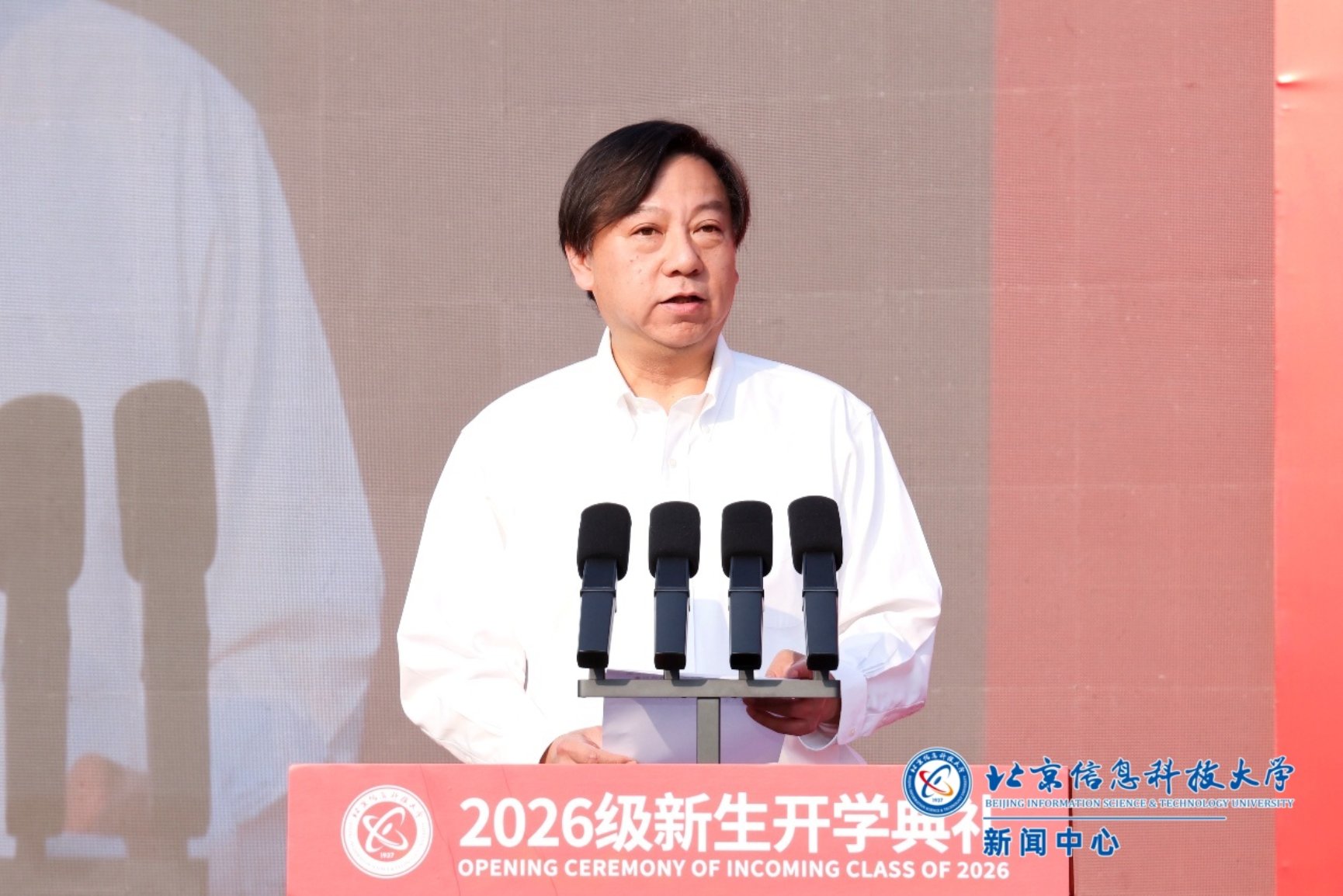
Dear members of incoming Class of 2026, distinguished faculty and staff, parents, families, and friends:
Good morning, and welcome.
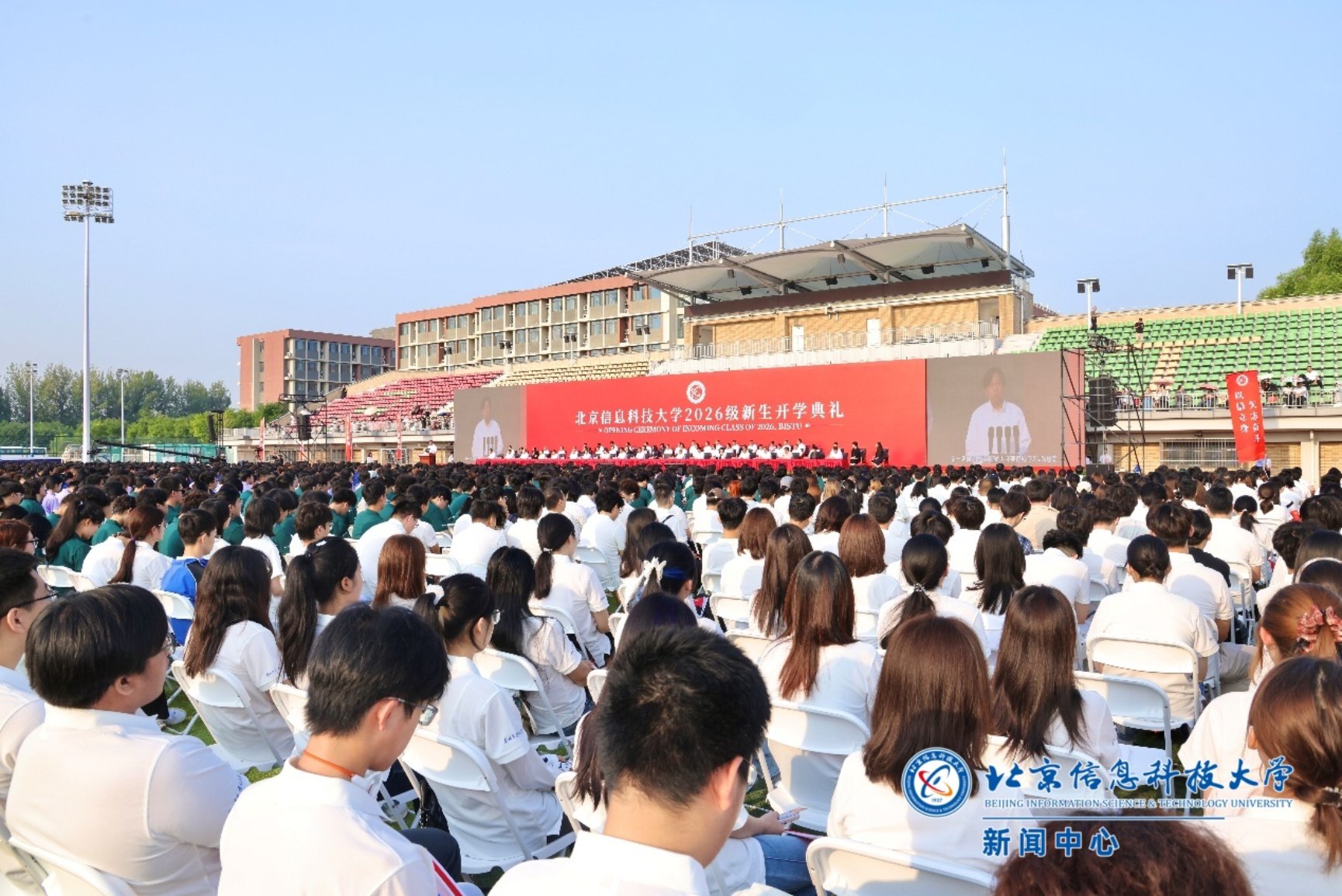
To the students of the entering Class of 2026, to our faculty and staff, and to the parents, families, and friends who join us today: it is a great pleasure to gather with you for one of the most meaningful traditions in the life of a university—the beginning of a new academic year, and the welcome of a new generation of students into our community.
On behalf of Chairman of the University Council, Prof. Xie Jiangling, and the entire University, I extend my warmest welcome to each of you. This year, including our Zhangjiakou Campus, more than 6,300 new undergraduate, master’s, and doctoral students have come to Beijing Information Science and Technology University to begin a new chapter in their lives.
To the parents and families here today: thank you. Thank you for the years of love, encouragement, sacrifice, and trust that have brought these young people to this moment. We know that sending a student to university is an act of hope. It is also an act of trust. Thank you for entrusting that hope to us. Please know that your children will be known here, supported here, and challenged here. They will be encouraged to grow not only in knowledge and skill, but also in independence, character, and confidence.
Every convocation makes a university young again. Beginning today, new names become part of our story. New footsteps will fill our classrooms, laboratories, libraries, residence halls, athletic fields, and the shaded paths that connect this campus to the wider world.
You arrive today with luggage, books, devices, and expectations. But you also arrive with questions—some clear, some still taking shape: Who am I? What do I care about deeply? What kind of life do I want to build? What kind of person can I become? And what contribution can I make to the world?
A university matters not only because it teaches knowledge. It matters because it gives young people the time, space, guidance, and community to live with these questions—and to begin answering them with courage and integrity.
This is a significant year for all of us. The year 2026 marks the beginning of China’s 15th Five-Year Plan period. It is also an important moment in our University’s own development, as we continue to strengthen our education system and accelerate our progress toward becoming a world-class university. This past admissions season, our entrance scores and rankings reached new highs for the third consecutive year. Our reputation continues to grow. And for the first time, the University entered the global top 1,000 in ShanghaiRanking’s Academic Ranking of World Universities. BISTU has grown bigger and stronger for the generations of students who came before you. And with you joining us today, I am confident that BISTU will become even bigger, even stronger, and even more extraordinary.
But this year is especially meaningful for another reason. You are the first entering class to begin your studies after the University’s full implementation of a more flexible credit-based academic system. For our undergraduates, this means greater freedom to explore fields of study, choose courses, plan academic pathways, and shape your own intellectual development. You will have more room to pursue your interests, combine different areas of learning, and design an education that reflects both who you are and who you hope to become. At the same time, we are advancing reforms that create stronger connections between undergraduate and graduate education. By opening course resources and training pathways across bachelor’s, master’s, and doctoral programs, we hope to give students at every level a broader academic horizon, a more continuous path of growth, and stronger opportunities for research and innovation.
In other words, the University will not simply hand you a fixed schedule and ask you to follow it. It will offer you a compass and ask you to learn how to use it. It will not only tell you where to go. It will help you learn how to decide why a path is worth taking. It will not be enough simply to complete the required credits. We hope you will build something deeper: the confidence to think for yourself, the discipline to master your field, and the resilience to face a future that is uncertain, complex, and full of possibility.
There is an old saying: “The wise create the rules; the less wise are bound by them. The worthy renew traditions; the unworthy are confined by them.” During your four years here — or perhaps longer — I hope you will not simply become people who have been shaped by the university. I hope you will become people who have helped shape the university. Create a course no one has offered before. Launch a project no one has attempted before. Take a path no one has walked before. That is the university spirit at its most vibrant, most courageous, and most alive.
So today, I would like to speak about one idea:turning freedom into purpose.
Freedom is one of the greatest gifts a university can give. But freedom does not mean doing whatever one happens to want in the moment. True freedom is not simply having more options. It is developing the judgment to choose well. It is not the absence of responsibility. It is the ability to listen for one’s calling amid the noise of the world, and then to act on it with discipline and courage.
The freedom created by our credit-based curriculum and our integrated undergraduate-to-graduate pathways is precisely this kind of freedom. It does not leave you alone in an open field without direction. It gives you a larger landscape in which to learn how to plan, how to choose, how to take responsibility, and how to grow. Whether you are an undergraduate exploring courses and majors, or a graduate student defining a research agenda and working through difficult problems, the task before you is not merely to complete a program designed by others. It is to become an active author of your own education.
At this important beginning, I would like to offer you three hopes.
First, I hope you will become people of judgment. Do not confuse what is popular with what is meaningful.
When you enter university, you will hear many voices. You will hear which majors are in demand, which industries are rising, which certificates are useful, which jobs are secure, which path seems most practical, and which choices others believe are “the right ones.” Such information has value. But if a life is shaped only by rankings, algorithms, market trends, and other people’s expectations, then even a person who seems to be moving with the times may in fact only be carried along by them.
Trends change. Deep interests endure. Markets shift. Real ability remains.
This is especially true in the age of artificial intelligence. By now, we all understand that AI can help you calculate a route, but it cannot decide your destination. It can generate language, but it cannot generate purpose. It can provide standard answers, but it cannot chart the course of a human life.
One of the first purposes of a university education is not to fill your mind with conclusions. It is to strengthen your capacity for judgment. For undergraduates, choosing courses should not be reduced to accumulating credits. It should be a way of building the architecture of your future. For graduate students, choosing a research direction should not mean chasing the newest trend. It should mean finding a question worthy of sustained attention, rigorous effort, and long-term commitment. I hope you will learn to locate your own coordinates—among the needs of society, the disciplines you study, your own strengths, and the interests that give you energy and purpose.
Do not ask only, “Is this course easy?” Ask, “Will it change the way I think?”
Do not ask only, “Does this field have prospects?” Ask, “Am I willing to devote myself to it over time?”
Do not ask only, “What is everyone else choosing?” Ask, “Does this choice bring me closer to the person I hope to become?”
A university is not a place where everyone is expected to run toward the same answer. It is a place where each student learns to discover the questions that are truly worth asking.
Second, I hope you will become people who connect. A major is a doorway, not a wall.
You have come to this University to study in different schools, disciplines, majors, and degree programs. But remember this: your field of study is a doorway through which you encounter the world. It should not become a wall that limits your imagination.
The great challenges of our time do not fit neatly within the boundaries of a single discipline. Artificial intelligence is about algorithms, but it is also about ethics, governance, law, labor, and human dignity. Intelligent manufacturing depends on engineering, but also on management, markets, supply chains, and industrial ecosystems. The low-altitude economy, quantum technology, cybersecurity, smart cities, life sciences, and health technologies—all of these emerging frontiers are shaped by complex relationships among technology, society, institutions, and people.
The people who will lead in the future will not only be those who are strong in one specialized area. They will be those who can connect forms of knowledge, move across boundaries, collaborate with people different from themselves, and reframe problems in new ways.
This is one of the reasons we are advancing the credit-based academic system and integrated undergraduate-to-graduate reform. We want to create more room for intellectual exploration and deeper connection. Undergraduates can build a strong foundation in their primary field while broadening their learning through minors, micro-credentials, honors programs, residential college education, industry-university collaboration, and international exchange. Graduate students can pursue cross-school, interdisciplinary, and platform-based coursework and research training that connects academic innovation with industrial needs and national priorities.
But let me emphasize this: crossing boundaries does not mean skimming the surface. It means taking deep, meaningful questions from one field and actively entering the toolbox of another. Interdisciplinary learning does not mean collecting labels. It is about connecting the underlying logic of different fields and developing perspectives that others do not have. Breadth without foundation is drifting. Breadth without depth is noise.
I hope you will have the courage to step beyond the comfort zone of your major, and also the patience to go deeply into at least one field. You need the imagination to connect outward, and the discipline to take root. Do not chase one fashionable topic today and another tomorrow, moving constantly from one track to the next without building lasting capacity. The best university education does not turn you into a polished instrument for someone else’s purposes. It helps you become a whole person: technically capable, intellectually serious, morally grounded, and humanly generous.
Technology may determine how fast we can move. The humanities help us decide where we ought to go.
Third, I hope you will become people of action. Do not wait for a perfect script before you begin.
Many students worry, especially at the beginning, that they may choose the wrong course, the wrong major, the wrong research topic, or the wrong path. But growth is not something we design perfectly in advance. Growth happens through engagement. It is clarified through action.
Life is not an instruction manual written before the journey begins. It is a map drawn as you walk. The greatest joy of life lies precisely in its uncertainty. No one can see the whole future clearly at eighteen or nineteen. No path comes with a guarantee of certainty. One of the great gifts of university life is that it gives you room to explore, room to try, room to make mistakes, and room to discover yourself as you come to understand the world.
Do not remain still because you are afraid of failing. Remember this saying: “Pessimists are always right, but optimists are always moving forward.” Many important discoveries begin with a small experiment. Many lifelong passions begin with an unexpected encounter. It may be a course that opens a new door. A professor who asks a question you cannot forget. An experiment that fails, but teaches you how to think. A lecture, a research project, a study trip, an international exchange. Or it may be a problem you had never noticed before—until one day it captures your imagination and calls you to years of effort.
The university will provide you with these “sparks” of inspiration: a more open curriculum, stronger advising and mentorship, richer research opportunities, and broader platforms for practice. Through integrated undergraduate-to-graduate pathways, we will also create more continuous routes for students who aspire to advanced study and scientific and technological innovation. But the ones who truly “ignite” the flame are those who take initiative.
Take the initiative to speak with your professors. Take the initiative to ask better questions. Take the initiative to join serious conversations. Take the initiative to enter laboratories and research groups. Take the initiative to know people whose backgrounds and ideas differ from your own. Take the initiative to seek answers not only in books and screens, but in the real world. Do not let your university years become merely an extension of high school. Do not let graduate study become merely the continuation of old habits. And above all, do not hand yourself over to the passive feeding of algorithms and fragmented information streams.
The greatest danger in growth is not moving slowly. It is never truly setting out. The greatest regret is not failure. It is leaving one’s possibilities forever unlived.
During your years here, I hope you will earn not only the credits required for your degree, but also a few credits that will never appear on a transcript—credits that will remain with you for life.
The first is the credit ofcuriosity: the habit of asking questions, seeking truth, and approaching the unknown with both hunger and humility. Let learning become not merely a requirement, but a way of life.
The second is the credit ofstillness: the capacity to think clearly in an age of noise. In a world of constant information, learn to pause, to examine, to reason, and to distinguish wisdom from volume. Do not drift with the crowd. Do not mistake repetition for truth.
The third is the credit ofagency: the courage to move from thought to action. When life presents difficult questions, have the courage to begin. Learn to turn ideas into plans, plans into practice, and practice into creation.
These credits may not immediately raise your GPA. But they will shape the depth, breadth, and direction of your life.
Dear the incoming Class of 2026, we live in a time of profound change. The years ahead will be critical for China as it advances high-level scientific and technological self-reliance and strengthens its role as a leading nation in education. They will also be years in which young people will have extraordinary opportunities—and extraordinary responsibilities. In such an era, universities cannot simply prepare students for the jobs of today. We must prepare you to confront the questions of tomorrow. We cannot merely teach existing knowledge. We must awaken your capacity to create new knowledge, new technologies, and new forms of value.
This is the deeper purpose of our credit-based academic system and our integrated undergraduate-to-graduate reform. We give you choices so that you may learn how to choose. We give you freedom so that, in the end, you may live for what you love.
Dear students, your university years will be long enough to change your habits, your vision, your character, and perhaps the course of your life. But they will also be short enough that, before long, they will become some of the most cherished memories of your youth.
So beginning today, cherish what this place offers you. Cherish the questions raised in class. Cherish the failures in the laboratory. Cherish the quiet hours in the library. Cherish the conversations and arguments with your peers. Cherish the efforts whose results you cannot yet see, but which are already shaping who you are becoming.
Today, you stand at the threshold of the University. You also stand at the threshold of the future. Ahead of you are courses waiting to be chosen, questions waiting to be answered, problems waiting to be solved, and possibilities waiting to be opened.
May you, here at BISTU, turn freedom into a sense of direction, turn choices into sound judgment, and temper your passion into long-term commitment. Pack those invisible credits into your journey’s luggage. Then, with confidence and conviction, step into every scene of the times that belongs to you.
Welcome to the University.
Thank you.